Friday, September 05, 2008


Wednesday, December 06, 2006
Why I Believe in God
Cornelius Van Til wrote a pamphlet called "Why I Believe in God," which you can find here. This is probably unlike any apology for the Christian Faith you've seen. Let me know what you think.
Wednesday, November 22, 2006
This is a really helpful site--I'll add it as a link soon. For now, click here for great movie, TV, music and game reviews.
A simple idea, at first
There are two and only two classes of men. There are those who worship and serve the creature and there are those who worship and serve the Creator. There are covenant breakers and there are covenant keepers. In all of men’s activities, in their philosophical and scientific enterprises and as well as in their worship, men are either covenant keepers or covenant breakers.
--Cornelius Van Til
--Cornelius Van Til
Sunday, September 24, 2006
Saturday, September 23, 2006
Perhaps I'm not a blogger at heart
It doesn't seem that I'm very passionate about blogging. I havn't posted since late May, and summer has been very eventful. Today I read two articles by two men that I respect: Michael Coren's comments on the Pope's speech may be read here and John Piper's comments here . It is becoming clearer that Islam is at war with unbelief (and we Christians qualify for that). The Christian world (and no, we're not "all Catholics") is not intellectually prepared to answer Islam. It is not that we have no answers, for we do. For the most part, Christians do not know enough about their own faith to deal with the challenges Islam presents.
Saturday, May 27, 2006

Is this offensive? It's not one of the infamous "Danish Cartoons" but certainly in the same spirit. I don't remember where I found it, but I did not create it. Back to the question, "Is this offensive?" One of the reasons that Westerners, living on a borrowed Christian worldview and culture (rapidly fading from memory), are not so upset about religious satire is that the Christian faith began with a martrydom, and has been fueled by martyrs' blood ever since.
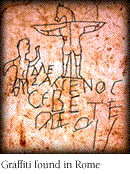 Is this offensive? It is anti-Christian grafitti found in Rome several decades after Christianity was established there. It depicts an ass being crucified, and the writing says something like, "Alexomenos worships his god," making fun of a local Christian.
Jesus' Christianity was never about military conquest and control, despite how it was misappropriated later by the state church. The Way was established in the crucible of persecution and suffering.

Friday, May 26, 2006
Perhaps a little housekeeping can get this back on track. Back in the BBS days I wrote volumes on the Wittenberg Door (note the CORRECT spelling) BBS. I was the owner of the site. All sorts of ideas were discussed, but most were on faith/atheism/philosophy/apologetics, etc. Of course in those pre-internet days, only one person could be logged on at a time, and we needed a dedicated phone line. There were probably more than 20 active BBSs in Hamilton at that time, and we had a lot of activity.
This seems to be as close to the old BBS as it gets.
My 2 cents regarding the so-called holy grail: After the "last supper," someone did the dishes. End of story.
This seems to be as close to the old BBS as it gets.
My 2 cents regarding the so-called holy grail: After the "last supper," someone did the dishes. End of story.
Friday, May 19, 2006
A brief review of The Da Vinci Code 19 May 2006
Scott Jacobsen
Pastor, Mountain View Christian Church
Hamilton, Ontario
I saw the movie when it opened May 19th, 2006. Unlike many of the professional reviewers I’ve read, I did not find the movie too "wordy" or that it "explained too much." If anything, the movie proceeded as if it assumed that the viewer had read the book. Having read the book, I noted a number of scenes that were adjusted to be more palatable. Some of the bigger whoppers (outright lies) that Brown uses in his book are missing or dumbed-down in the film. I don’t go to many movies, so I am always easily impressed by the large screen. The pace, setting, and effects of the film were excellent.
My complaint with the film is, of course, with the plot. If it had been any other plot, it would have been a good detective story. But the plot itself, which is supposedly fiction but touted by Dan Brown as factual, is the problem. There are many helpful resources to discover the errors of history, theology, architecture, politics and art in the movie, so I won’t go into that here. It is the not-so-hidden agenda of Brown to re-image Jesus and therefore all of church history that irks many Catholics and Christians. If I were a Roman Catholic, I would be seriously offended by the implications of the film. It borders on slanderous against Catholicism and Opus Dei. To historical, Biblical Christianity it is a crude, ignorant joke; except Brown is neither crude nor ignorant. He knows what he is doing, and the book and movie can only be described as propaganda. Repeat an old lie often enough and with enough technique and soon it will become tomorrow’s truth. The lie in the story is ancient: either Jesus is all divine, but not really human at all; or He, being fully human, is only human. Both of these errors were met in the Nicene Creed.
Not found in the book, is a speech by Hank’s character Langdon after the identity of the grail is revealed. In it, he muses that whether Jesus was divine or human (it can’t be both in Brown’s theology) doesn’t really matter. If belief is helpful, that’s what matters. I could almost hear Lennon’s Imagine in the background.
After the film I saw a lot of stunned looks on the mostly over-50 audience (I saw it at noon). Information flows in this film so fast that it is impossible to counter the propositions stated. Before one can recover from one statement, another assault on faith is at hand. I wouldn’t recommend the movie unless a viewer is prepared to read the book and to delve into the bald misrepresentations that Brown offers there. Most non-Christians are probably too Biblically illiterate to understand the issues, and will just see it as another wave in the flood alternative Jesus stories going about today. The myths of the Da Vinci Code come with such authority and arrogance that the mild protestations of Langdon (Hanks) are swept away.
This movie has given Christians the opportunity to explain the true, historical, ancient and original Gospel. We do not need to become experts in the Da Vinci Code, which will very quickly be yesterday’s news. Rather, we need to be well acquainted with "the faith that was once for all entrusted to the saints."
©Scott Jacobsen, 2006. Permission granted to reproduce in entirety, with this note.
Monday, November 14, 2005
Confessions of a reluctant activist.
Recently, I attended two conferences. The first, hosted by a Christian law firm, advised attendees on the state of religious freedom in Canada today, and the rights and obligations of the church. The second aimed at inspiring Christians to greater political involvement. Neither presented an optimistic view religious freedom in Canada. The first instructed Christians how to be involved legally in the Canadian Public Square, and the second warned of the marginalisation of the church. I longed for a third seminar: "How To Sleep At Night in a Scary World." I get exhausted just thinking about the important issues facing Christians each day. There are many urgent matters that confront us globally, nationally, and in our own back yard.
For example, as I write this, the house next door is surrounded by police cruisers. But this is the norm for our neighbourhood. Our street is under siege from drug dealers, prostitutes, users, slum-lords, and other criminals. We choose to live here because it is our calling to do so, and we sleep well at night (ok, most nights), because this too is our Father’s world. God is as present and sovereign here as He is in the suburbs.
But there are larger political issues, such as same-sex marriage and the right of religious protest. If I allowed every urgency, every issue, every cause to become "the" cause, I couldn’t make it a week.
I am a reluctant activist. I do what I can within the limits of time and gifts God has granted me. So whether I deal with same-sex marriage and its implications, or the drug deal going down in the alley behind my house, I must remember that neither manner of chaos shall prevail over the ever-advancing Kingdom of God. Marriage will not be changed, because no church or government has real power or ability to change it. Neither can God be legislated out public life. Nor will lawlessness finally prevail in my neighbourhood. This place too, is His. He uses our presence as salt and light, globally and locally, but we are in no sense indispensable to His work. God is still sovereign and in control of the events of humans. Now I can get some rest.
©2005 Scott Jacobsen, Published in the Winter 2005 Alberta Bible College Evangel
Saturday, August 27, 2005
Unpublished Letter to the Editor
Re: Up in Smoke Café
The recent media attention given to the pro-marijuana protest and the Up in Smoke Café raises some important questions about the proposed legalisation (or decriminalization) of marijuana.
Contrary to popular myths, studies have shown that marijuana is addictive, usually a gateway drug to harder substances (coke, etc), is dangerous both from a personal health consideration as well as motor-vehicle impairment. It is more physically dangerous than cigarettes, and has been shown to be very harmful to the unborn children of smokers.
Perhaps the saddest thing is that those who use marijuana can permanently impair their ability to think. Habitual users of marijuana will likely experience some irreversible brain damage. What does the future hold for these users? Or for that matter, what about the future of their children? Those who argue for the repeal of marijuana laws are condemning future generations to low income and diminished opportunities. Can a daily user adequately provide for their children? Will a child do as well in school when her parent(s) are regular users of marijuana? Will children of marijuana users be given the same chances to be drug-free later in life? Studies and evidence indicate that the answer to these questions must be "no."
The current attitude seems to portray marijuana use as a strictly private affair, and that laws should somehow reflect this privacy. But when one considers the long-term cost to society of marijuana decriminalization, it true cost becomes clear. The reality is that the cognitive damage done to smokers will be the debt of our time and for future generations. There are many things that can cause brain injury: birth defects, accidents, disease, to name a few. Those who suffer from these must be compassionately cared for by the larger community. But must this same community be further burdened by those who so willingly bring this damage upon themselves? Habitual use of marijuana will create more dependents than social services can sustain. This will eventually result in more cruel cutbacks to welfare that affect all who rely on such services. The decriminalization of marijuana will be construed to bestow a new "right" –a right to injure oneself deliberately and permanently, and then to expect compensation at taxpayer expense.
Another argument for the decriminalization of marijuana is that it is no worse than alcohol. It is also asked if it isn’t somehow hypocritical to allow one substance and ban the other. Even if it were true that marijuana is less harmful than alcohol, why would it be wise to make another legal-but-harmful substance available to the public? If we have one unmanageable problem, how would adding another help?
Politicians and the public need to carefully weight the long-term consequences of marijuana use and its decriminalization. Failure to do so is a lapse of judgement we cannot afford.
Marijuana use destroys lives, children, and our community.
Subscribe to:
Posts (Atom)


 Posts


